
Sensitive data passes through several people over its lifecycle: legal teams, compliance officers, IT, and sometimes an external auditor, too. While redaction tools protect confidential information from unauthorized exposure, they don't show who can access, modify, approve, or export that data as it moves through different systems and processes.
Read on to learn why it is important for organizations to up their access control game with enterprise-grade security.
When Easy Access Becomes a Security Risk
Many organizations still run data access like a light switch. On or off, nothing in between. That worked fine back when data lay in a shared drive, and a handful of people touched it. It stops working the moment data starts moving across cloud platforms, vendor systems, contractor logins, and automated pipelines, which is where most enterprise data actually lives now.
The real problem shows up when teams have access to more than they need. A finance analyst pulling an invoice doesn’t need the same view as a compliance officer running a full audit. Standardized access across teams makes an attacker's job easier; a threat actor doesn't even need to break encryption if an overprivileged account already has legitimate access.
Shared logins make this worse. Three people using one account means there's no sure way to say who actually opened a file or changed a field. Investigations stall, accountability disappears, and permissions just keep existing. Someone changes teams or leaves a project, but their old access stays active for months, unused.
Where Traditional Access Models Break Down
Role-based access control allows only authorized people access to sensitive data. But they are static in nature. A login at 2 a.m. from an unrecognized device should not be treated the same as a routine login at 10 a.m. from a known laptop. That’s where role-based systems falter: they check the role but do not ask whether the request itself makes sense.
That gap gets more dangerous as redaction platforms take on regulated data such as healthcare records, financial statements, and government contracts; a technically valid login can still mean a real problem.
What Weak Governance Actually Costs
Weak governance proves to be extremely costly for organizations. An unauthorized export can bring legal, finance, and executive teams together to identify the resource and curtail the impact.
- Audit failures are expensive, but reputational damage is worse. When audits fail, companies pay fines. But when a client loses trust because your access controls were weak, it takes much longer to repair.
- Different regulations, same underlying demand: When a breach happens, regulators like HIPAA, GDPR, and SOX all want to know who accessed the data, when they did it, and why they had permission to.
- A clean redaction alone does not pass an audit. A tool that hides fields perfectly but cannot produce an access trail still fails. There is no need for a leak or data exposure for the audit to fail.
The Case for Layered Authorization
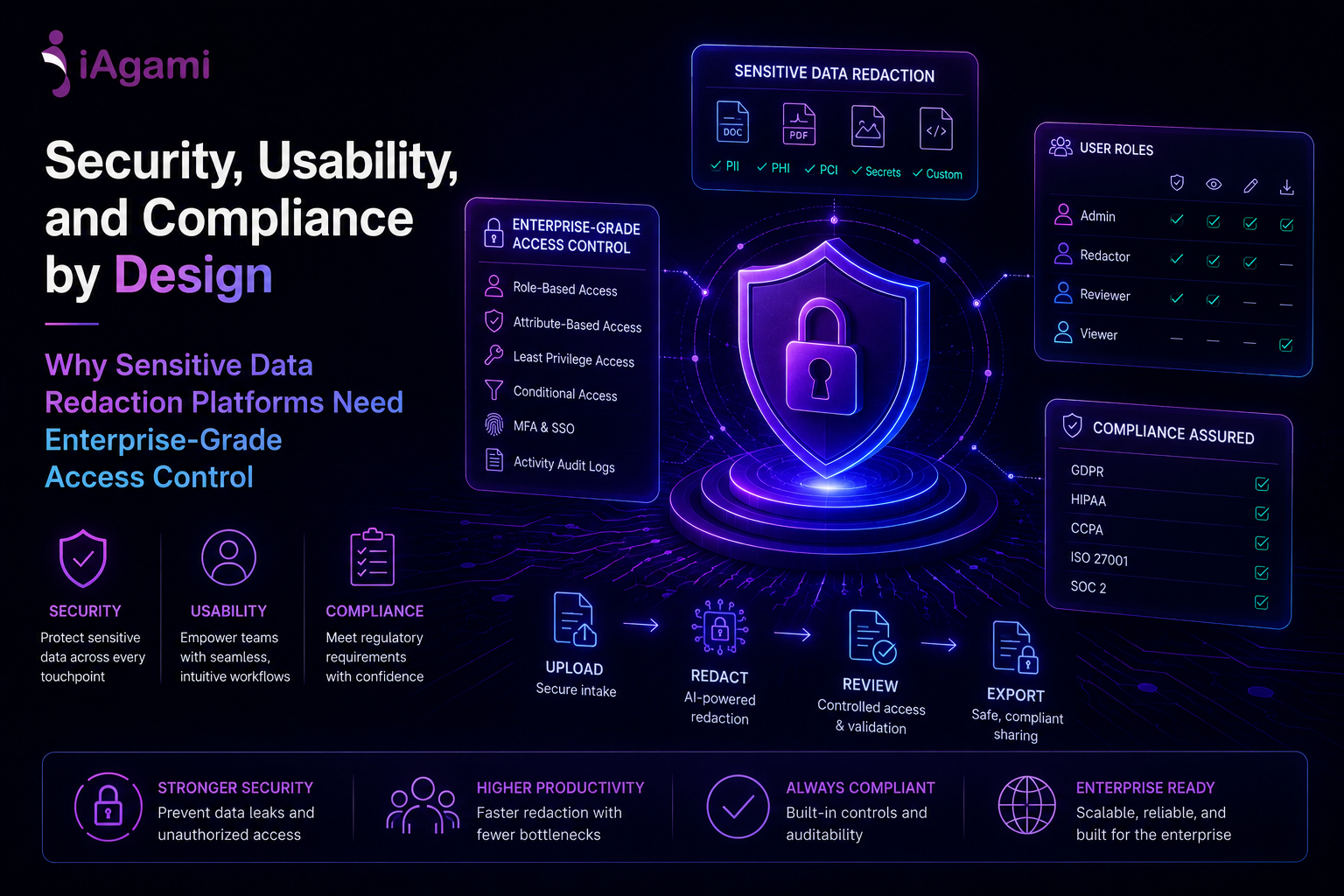
Layered authorization fixes what role-based models miss. It doesn’t just ask "does this person have the role" but also who they are, where the request is coming from, and whether the pattern looks normal.
If one layer fails or gets misconfigured, the others are still standing between an unauthorized user and the data. For redaction platforms specifically, that matters more than usual: a single point of failure can expose the exact information the system exists to protect.
- Maps access to specific data types and workflow stages instead of flat job titles, so people see only what their actual function requires.
- Brings in real-time logic through policy enforcement, flagging anomalies that a static role check would wave right through.
- Enables multi-factor authentication, ensuring policy layers don’t fail even if the identity behind it is already compromised.
How iAgami Turns Access Control into a Real Governance Framework
iAgami builds identity and access management systems for exactly this level of complexity. Our framework is designed around how data actually moves through an organization. We work with compliance, IT, and security functions to map real workflows, find where the old role-based setup breaks down, and rebuild governance so it holds up as the organization scales.
We align role hierarchies, policy engines, and authentication requirements to the specific regulatory environment you operate in. The output is a system that can answer who accessed what and under what conditions, every time.
Build the Right Authorization Structure with iAgami
If your current access control mechanism cannot confirm who touched sensitive data, when, and under what authority, that is worth addressing now.
Connect with our data experts to build an authorization framework designed to withstand real regulatory scrutiny, not just internal review.
FAQs
What is layered authorization?
Layered authorization combines multiple checks, including roles, policies, and authentication, to control access.
Why do traditional access controls fail in regulated industries?
Traditional access control methods ignore context and behavior, leaving gaps that regulators catch during audits.
How does multi-factor authentication (MFA) strengthen data governance?
MFA adds a second identity check beyond passwords, so stolen credentials alone are not enough to get in.