
Mainframe Modernization Without Disruption: Where Generative AI Adds Real Value
Mainframe systems still work.
That is exactly why modernization becomes difficult.
Payroll runs through them.

Transactions get processed through them.

Critical business operations depend on them every day.
Most organizations avoid touching these systems because stability matters more than experimentation.
The moment modernization enters the discussion, hesitation appears.
The concern is not whether modernization is necessary.
The concern is:
What happens if something breaks?
For enterprises running banking systems, public infrastructure, retail platforms, insurance operations, or logistics environments, downtime is not a technical inconvenience.
It becomes a business crisis.
This is why many modernization initiatives stall before they fully begin.
Organizations understand the need to evolve.
But fear of disruption slows decision-making.
Generative AI introduces a different modernization path.
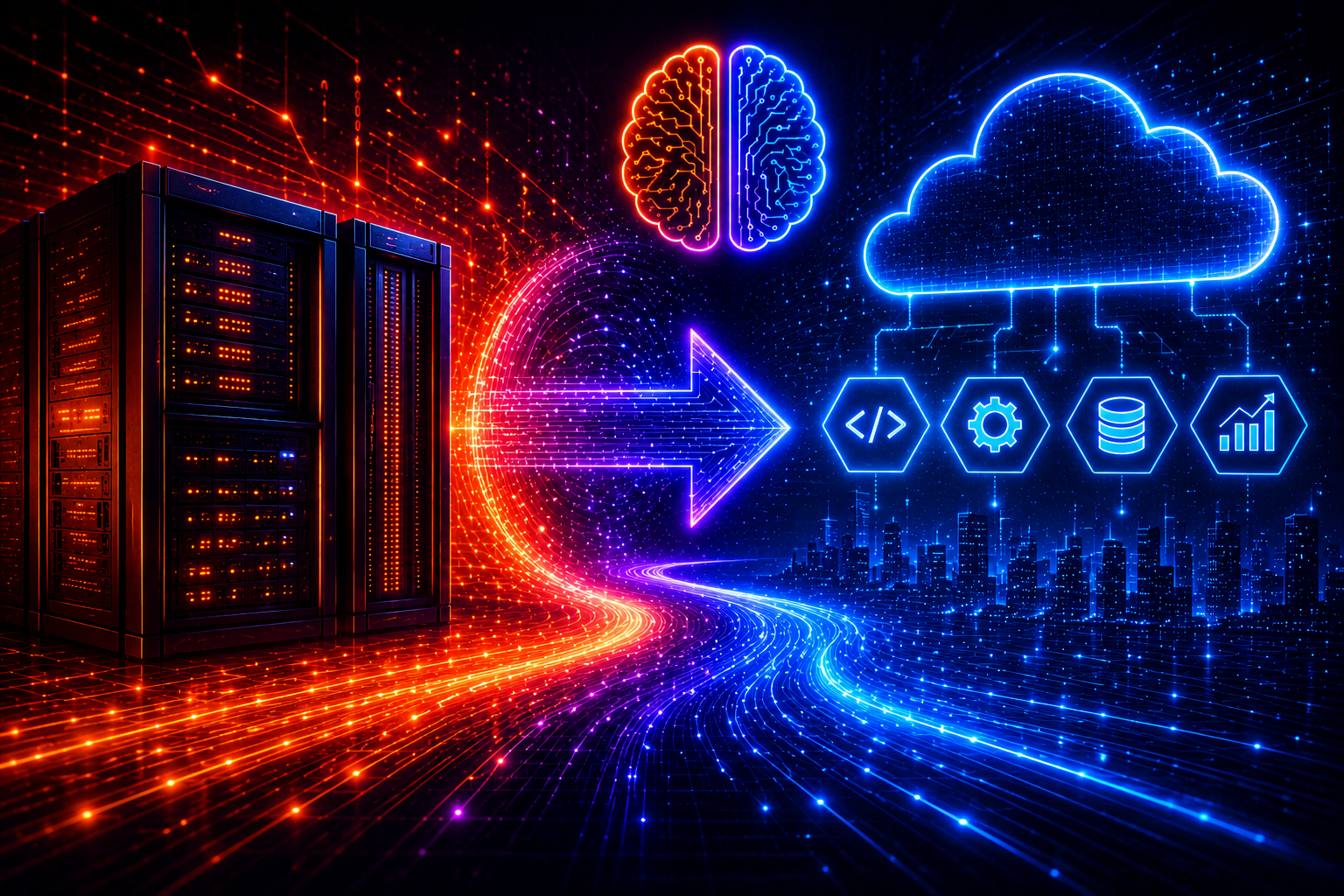
Instead of replacing everything at once, organizations can modernize incrementally, validate continuously, and evolve systems without interrupting business operations.
This changes modernization from a high-risk replacement project into a controlled operational transition.
1. What Mainframe Modernization Actually Means
Mainframe modernization is not simply about replacing old infrastructure.
It is about enabling legacy systems to operate effectively alongside modern cloud environments, APIs, DevOps pipelines, and scalable digital architectures.
Many enterprise systems still rely on:

COBOL

IMS

CICS

VSAM

IBM Z environments
These systems were built for reliability and long-term operational stability.
In many cases, they succeeded for decades.
But over time, new challenges emerged:

A shrinking COBOL talent pool

Limited integration flexibility

High operational maintenance costs

Slow release cycles

Growing dependency on undocumented workflows
Modernization itself can take multiple forms:
Rehosting:

Moving workloads with minimal changes
Replatforming:

Migrating workloads into newer environments with optimization
Refactoring:

Improving and restructuring existing code
Re-architecting:

Rebuilding systems into modern architectures
The business objective remains consistent across all approaches:

Reduce operational risk

Improve agility

Lower maintenance costs

Enable cloud adoption

Support faster delivery
The modernization market reflects this urgency.
Organizations across industries are increasing investments because legacy dependency continues to grow while modernization pressure intensifies.
2. Why Traditional Modernization Approaches Often Fail
Many modernization initiatives struggle for predictable reasons.
Large-Scale “Big Bang” Replacements Introduce Risk
Traditional modernization plans often attempt complete replacement in a single large transition.
On paper, this approach appears efficient.
In practice, it introduces:

System downtime

Data inconsistencies

Operational instability

Release failures

Business disruption
When a single deployment impacts multiple business systems simultaneously, recovery becomes difficult and expensive.
Lack of Documentation and Institutional Knowledge
Legacy systems frequently contain:

Outdated documentation

Undocumented workflows

Hidden dependencies

Business rules buried directly inside application logic
Many organizations rely heavily on a small number of experienced engineers who understand how these systems actually operate.
When those individuals leave, critical operational knowledge leaves with them.
Testing and Validation Become Bottlenecks
Manual testing slows modernization significantly.
Common challenges include:

Incomplete test coverage

Regression risks

Delayed release cycles

Limited validation confidence
Teams become increasingly cautious because uncertainty grows with every release.
Resistance to Change Slows Progress
Resistance exists for practical reasons.
Engineering teams fear instability.

Leadership fears downtime.

Business teams fear operational disruption.
As a result, modernization gets postponed repeatedly while legacy risk continues increasing in the background.
3. A Different Model: Incremental AI-Assisted Modernization
Generative AI enables a fundamentally different modernization strategy.
Instead of replacing systems all at once, organizations can modernize gradually.
Module by module.

Workflow by workflow.

Validation by validation.
Legacy and modern systems continue operating in parallel during the transition.
This creates a stable fallback path while modernization progresses incrementally.
Business continuity becomes part of the modernization design itself rather than a constraint teams struggle to manage.
This shift changes how modernization projects are planned, executed, validated, and measured.
4. Where Generative AI Adds Real Value
AI-Driven Discovery and System Understanding
Before systems can be modernized, organizations need to understand what currently exists.
Historically, this phase consumed months of manual effort and still produced incomplete visibility.
Generative AI changes this process significantly.
AI-assisted tools can:

Analyze legacy codebases

Map business logic

Identify dependencies

Surface hidden workflows

Generate missing documentation
What previously required large specialist teams and lengthy analysis cycles can now happen faster and with greater completeness.
Knowledge that previously existed only inside experienced engineers’ memory becomes structured, searchable, and reusable.
AI-driven discovery also uncovers hidden risks early:

Unrecorded dependencies

Hidden workarounds

Unexpected data relationships

Operational edge cases
Finding these issues early prevents costly surprises during migration.
Intelligent Code Transformation and Incremental Migration
Once systems are understood, transformation can begin incrementally.
Generative AI supports:

COBOL-to-Java conversion

COBOL-to-Python conversion

IMS modernization

CICS transaction transformation

API-compatible service restructuring
AI handles repetitive transformation work while engineers focus on validation and operational accuracy.
This is not a fully automated process.
Human expertise still drives:

Validation

Business logic interpretation

Risk management

Architectural decisions
The difference is that engineers start with validated AI-assisted outputs instead of beginning from scratch.
This reduces:

Transformation timelines

Manual effort

Human conversion errors

Operational risk
Most importantly, migration happens incrementally.
Individual components are modernized independently, validated continuously, and deployed gradually.
Legacy and modern systems coexist safely throughout the transition.
Automated Testing and Continuous Validation
Testing remains one of the largest challenges in legacy modernization.
Many systems lack complete documentation or formal test coverage.
AI improves validation by:

Generating automated test cases

Creating synthetic test datasets

Comparing outputs between legacy and modern systems

Identifying behavioral mismatches continuously
Instead of relying entirely on manual validation, organizations gain ongoing visibility into modernization accuracy.
This increases release confidence significantly.
Knowledge Capture and Long-Term Resilience
As AI analyzes systems, it continuously produces:

Process documentation

Workflow maps

Data structure explanations

Business logic visibility
Unlike static documentation created manually, AI-generated documentation reflects actual system behavior.
This improves long-term maintainability and reduces dependency on tribal knowledge.
AI-assisted development workflows also improve:

Code review efficiency

Debugging speed

Refactoring productivity

Developer onboarding
The engineering delivery pipeline becomes faster while maintaining operational discipline.
FAQs
How do you modernize a mainframe without downtime?
By modernizing incrementally, running legacy and modern systems in parallel, and validating outputs continuously before production cutover.
Is Generative AI reliable for code transformation?
Yes. When combined with human validation and automated testing, AI significantly improves transformation speed while maintaining logic accuracy.
What is the biggest risk in mainframe modernization?
Operational disruption is the largest risk. Incremental migration and continuous validation reduce this risk significantly.
How does AI accelerate modernization timelines?
AI automates discovery, dependency analysis, code transformation, documentation, and testing workflows, reducing manual effort substantially.
Why should organizations consider iAgami for modernization?
iAgami combines AI-enabled workflows, structured delivery governance, incremental migration strategies, and continuous operational validation to modernize systems without disrupting business operations.